Archives
-
Issue № 8
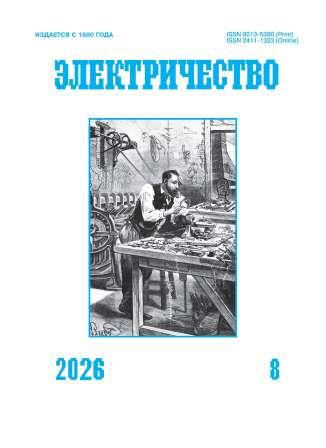
No. 8 (2026)On the Cover – Zenob T. Gramme in the laboratory (engraving by the French artist Jules-Descartes Férat).
Source: Desbeaux E. Physique populaire. Paris: Librairie Marpon et Flammarion, 1891, 835 p.
200 years ago, in 1826, the outstanding Belgian and French engineer, inventor and entrepreneur Zenobe-Théophile Gramme was born, who developed many pioneering designs of direct current and alternating current machines. The engraving depicts a young inventor bent over an electrical winding. Behind him is the famous Alliance generator, next to it is a small generator for laboratory research. The engraving masterfully illustrates the main milestones in Gramme's life.
-
Issue № 7
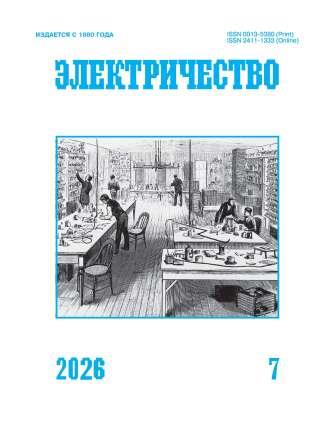
No. 7 (2026)On the Cover – The Edison Laboratory in Menlo Park
Source: Edison's Perfected Electric Light. – Frank Leslie's Illustrated Newspaper, 1880, vol. 49, No. 1267, pp. 353–354.
150 years ago, in 1876, Thomas Alva Edison founded the world's first industrial research center in Menlo Park, New Jersey, USA, where inventions were transformed into commercial products in a short time. Edison assembled a brilliant team of mechanics, physicists, designers, and workers. Many devices that have changed the world have been created or significantly improved here. It was in Menlo Park that the electric lighting system (from generator to light bulb) was developed, which significantly influenced the development of electrical engineering worldwide. -
Issue № 6
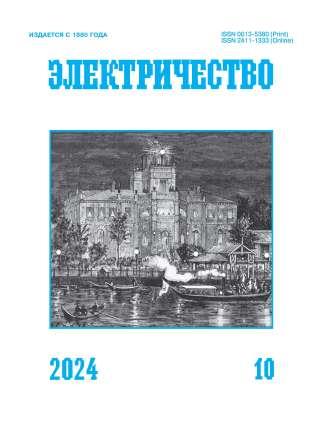
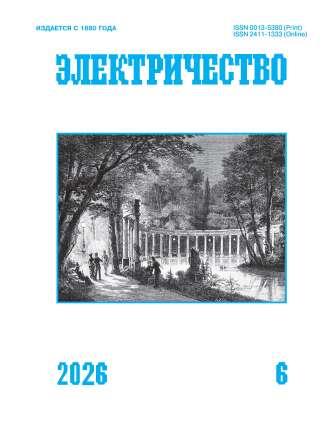
No. 6 (2026)On the Cover – Lighting of the Corinthian colonnade of Paris's Monceau Park with Yablochkov candles.
Source: Clémenceau P. L'éclairage du parc Monceau avec des bougies Jablochkoff. – La Lumière Électrique, 1884, No. 1, pp. 74–76.
150 years ago, in 1876, P.N. Yablochkov received a patent for an electric candle. This invention turned out to be one of the starting points in history. Electrical engineering has become a powerful driving force of global progress. The Russian Light was simple, reliable, and pleasing to the eye. 12 Yablochkov arc lamps were installed in one of the most beautiful places in Paris, Monceau Park. The magazine "La Lumière Électrique" wrote: "The effect created is very majestic, and the colonnade, one of its most beautiful spots in the park, appears at night with grace and grandeur that daylight cannot fully convey." -
Issue № 5
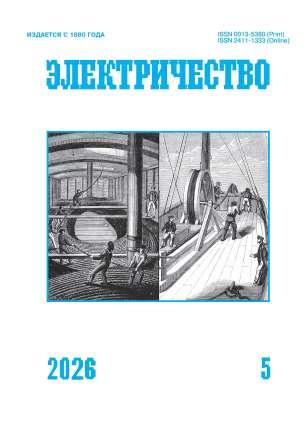
No. 5 (2026)On the Cover – Laying of a telegraph cable across the English Channel in 1851
Source: Figuier L. Les merveilles de la science ou Description populaire des inventions modernes. Paris: Furne, Jouvet et C., 1868, 703 p.
175 years ago, after several unsuccessful attempts, an underwater cable was laid between Dover (England) and Calais (France). The cable was gutta-percha insulated and protected from external influences by steel wire. Before diving into the sea, the cable from the ship's hold was fed to two pulleys and then made several turns around a wooden drum with a diameter of 10 m. -
Issue № 4
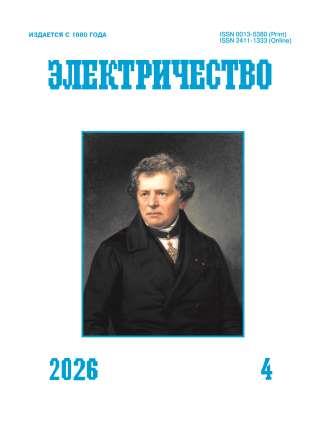
No. 4 (2026)On the Cover – Georg Simon Ohm.
Source: Ohm G.S. Die galvanische Kette, mathematisch bearbeitet. Berlin: Bei T.H. Riemann, 1827, 245 p.
200 years ago, in 1826, Georg Simon Ohm, a mathematics teacher in Cologne, formulated a fundamental principle in electrical engineering – the linear relationship between current and electric voltage in a section of a circuit. The following year, 1827, his book "A Galvanic Circuit Developed Mathematically" was published, where he deduced the law U = I R. Ohm's discovery was strongly opposed by the German scientific community, which was dominated by natural philosophy, which considered the mathematical description of physical phenomena to be an unacceptable simplification. Because of this harassment, the scientist was fired from his job and found himself isolated and poor for many years. Nevertheless, the author wrote: «May the benevolent viewer deign to accept my work with the same love for the subject from which it was born!" -
Issue № 3
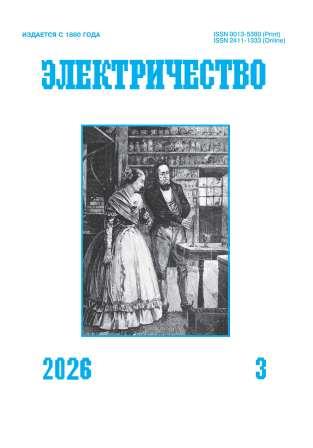
No. 3 (2026)On the Cover – Michael Faraday and his wife Sarah Bernard.
Sources: Brackett C.F. et all. Electricity in Daily Life: A Popular Account of the Applications of Electricity to Every Day Uses. London: Kegan Paul, Trench, Trübner & CO, 1891, 288 p.
205 years ago, in 1821, Michael Faraday, an assistant at the Royal Institute in London, invited his wife to his laboratory to share his delight after a successful experiment. There was a vessel filled with mercury on the table. A current through a vertical copper wire set in motion a magnet floating in a liquid metal. It was the first ever electric motor model. The scientist lived with his beloved wife for forty-six years. -
Issue № 2
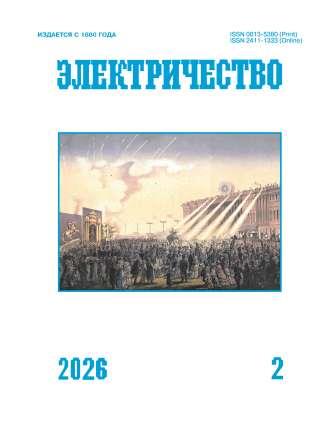
No. 2 (2026)On the Cover – Festive illumination in Lefortovo in 1856.
Sources: Velikolepnyy feyerverk po sluchayu koronatsii pri 1-m i 2-m kadetskih korpusov 17 sentyabrya 1856 goda (Magnificent Fireworks on the Occasion of the Coronation of the 1st and 2nd Cadet Corps on September 17, 1856). M.: Litografiya izdatelya A. Rudneva, 1856.
Rapport fait par M. Le Roux, au nom du comité des arts économiques, sur un régulateur pour la lumière électrique présenté par M. Spakowski, de Saint-Pétersbourg. – Bulletin de la Société d'Encouragement pour l'Industrie Nationale, 1862, Tome 9, pp. 270–271.
170 years ago, in 1856, in Lefortovo, participants in the celebrations dedicated to the coronation of Emperor Alexander II witnessed the first festive electric illumination in Russia. The battery, assembled from 600 Bunsen cells, powered several electrical regulators designed by Alexander Ilyich Shpakovsky, also called "electric suns." The orchestra of 3,000 musicians was accompanied by artillery fire. The fuses of the guns were electric and the shots were controlled remotely using a special keyboard instrument. -
Issue № 1
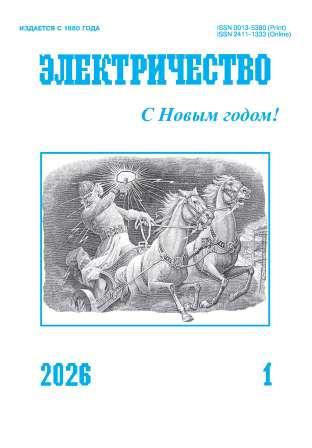
No. 1 (2026)On the Cover – Allegorical representation of Electricity "Thor riding on his chariot".
Source: Borodin D.A. Boginya elektrichestva (The Goddess of Electricity). M.: Penta, 2019, 143 p.
The engraving depicts the Scandinavian God Thor driving a chariot drawn by two horses. Thor holds in his hand the hammer Mjolnir, which emits lightning and light, embodying the power and energy of electricity. In the background (on the right) is a power line symbolizing the transition from the mythological understanding of lightning to the modern use of electricity. -

Issue № 12
No. 12 (2025)On the Cover – Mining operations using an electric Gram motor.
Sources: Soulages C.-C. Application de L'électricité au Percement des Galeries Souterraines. – La Lumière Électrique, 1883, No. 49, pp. 459.
Dinamomashina v ee istoricheskom razvitii. Dokumenty i materialy (The Dynamo in Its Historical Development. Documents and Materials) / Comp. D.V. Efremov, M.I. Radovsky; Ed. by Academician V.F. Mitkevich. L.: Izd-vo AN SSSR, 1934, 560 p.
155 years ago in 1870, the Belgian electrical engineer Zenobe-Théophile Gramme received a patent for a DC generator. This machine combined several of the latest achievements of the time. Soon, the Gram Company organized the mass production of DC generators and motors, which found wide application in industry. The figure shows a "hammer drill for mine galleries" with a Gramme design motor.
-
Issue № 10
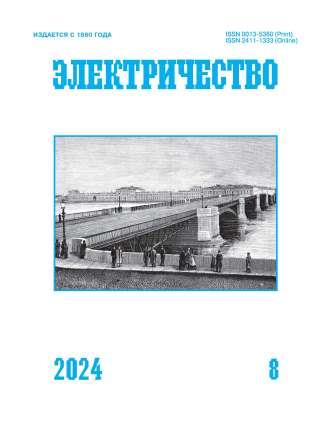
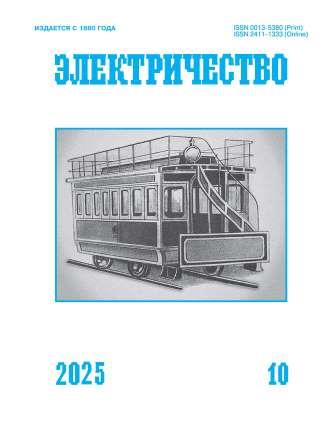
No. 10 (2025)On the Cover – An electric tram designed by F. A. Pirotsky.
Source: Russkiy invalid – in Russ. (Russian Invalid), 1880, Sep. 16, No. 204, pp. 2.
145 years ago, in 1880, in St. Petersburg, Russian engineer-inventor, staff Captain Fyodor Apollonovich Pirotsky conducted tests of Russia's first electric tram. A DC voltage of 100 V was supplied to the motor via rails. The path was only 85 m long. The car was moving at a speed of 10–12 km/h.
-
Вulletin № 11
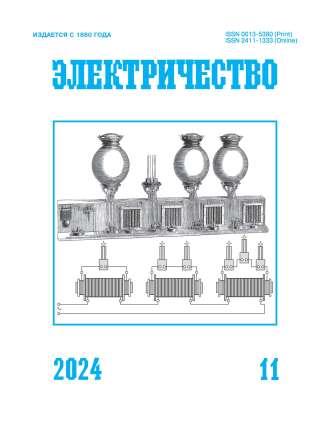
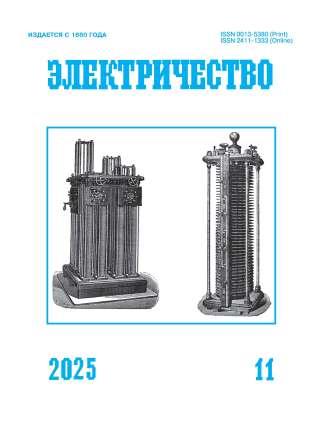
No. 11 (2025)On the Cover – "Secondary generators" by Lucien Gaulard.
Source: Commémoration du Cinquantenaire des Premières Realizations de Transmission d’Énergie par l’Électricité. Paris: Revue Générale de l’Électricité, 1935, 67 p.
The "secondary generator" is the forerunner of the modern transformer, which Lucien Gaulard (1850–1888), a French electrical inventor, was the first to use in practice as a converter of high single-phase voltage to operating voltage to power lighting devices located at a considerable distance from the energy source. (On the 175th anniversary of L. Gaulard’s birth).
-
Issue № 9
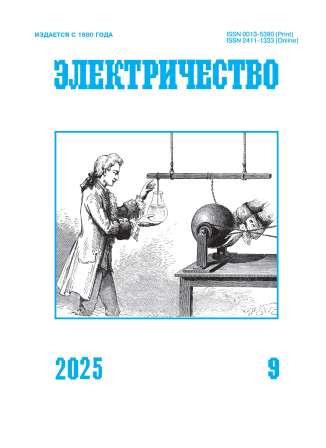
No. 9 (2025)On the Cover – The invention of the "Leyden jar".
Source: Privat-Deschanel A., Everett J.D. Elementary Treatise on Natural Philosophy. Part III: Electricity and Magnetism. New York: D. Appleton and Company, 1891, 609 p.
280 years ago in 1745, Dutch physicist Pieter van Musschenbroek from Leiden, along with his student Andreas Cunaeus, invented the "Leiden jar", the first capacitor. Trying to "condense" electricity from an electrophoretic machine in a vessel with water, the assistant received a powerful electric shock, from which he could not recover for several days. Scientists were interested in the case, and soon the first accumulators of electric charges appeared.
-
Issue № 8
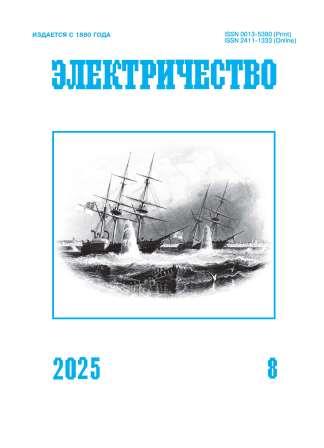
No. 8 (2025)On the Cover – The bombing of British ships by Russian mines. 1855.
Source: Razdolgin A.A., Skorikov Yu.A. Kronshtadskaya krepost’ (The Kronstadt Fortress). L.: Stroyizdat, 1988, 420 p.
170 years ago, during the Crimean War, electroplated mines designed by Boris Semenovich Jacobi and pyrotechnic mines by Emmanuel Nobel thwarted the plans of the Anglo-French squadron to break through to St. Petersburg. Jacobi's galvanic mines also prevented the enemy from capturing the important fortress of Sveaborg, which defended Helsingfors (now Helsinki).
-
Issue № 7
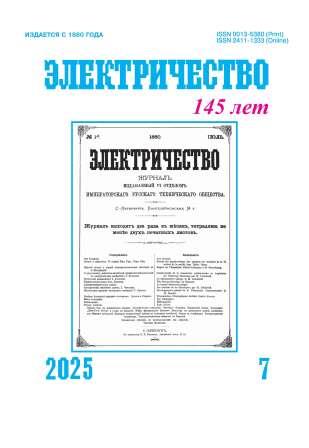
No. 7 (2025)On the Cover – Cover of the “Electricity” Journal's First Issue, 1880.
Source: Archive of the editorial office of the journal "Elecktrichestvo", National Research University "MPEI".
145 years ago, in July 1880, the first issue of the journal "Electricity" was published, published by the VI Department of the Imperial Russian Technical Society.
-
Issue № 6
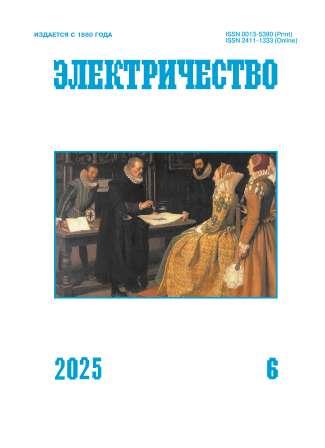
No. 6 (2025)On the Cover – William Gilbert demonstrates a magnet to Queen Elizabeth I in 1598 (Artist is Ernest Board).
Source: William Gilbert of Colchester, physician of London. On the magnet, magnetick bodies also, and on the great magnet the earth; a new Physiology, demonstrated by many arguments & experiments. London: Chiswick Press, 1900, 247 p.
425 years ago, in 1600, the English physicist and court physician to Queen Elizabeth I, William Gilbert, published in Latin a six–volume treatise "De magnete, magneticisque corporibus et de Magno Magnete Tellure" (On the magnet, magnetic bodies and a large magnet – the Earth), which outlined the first theory of electricity and magnetism. Hilbert considered the earth to be a large magnet, the poles of which coincide with geographical ones.
-
Issue № 5
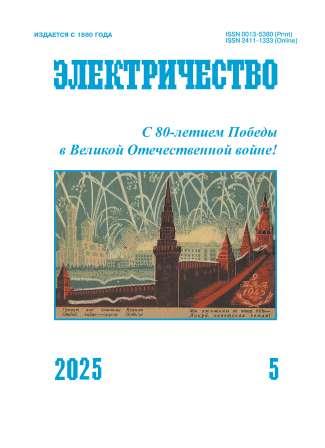
No. 5 (2025)On the Cover – Postcard “Victory salute. May 9, 1945. Red Square. Moscow”.
Source: Post Card Л19155. М.: Izdatel’stvo hudozhestvennoy masterskoy TsDRI, 02.06.1945.
The first postwar issue of the journal “Electricity” (No. 6, 1945) begins with an article by V.L. Komarov, President of the USSR Academy of Sciences, which says: “The Red Army has hoisted the shining banner of victory over Berlin. ... The enemy is defeated. ... Moscow saluted the victors with gun salvos and fireworks“.
-
Issue № 4
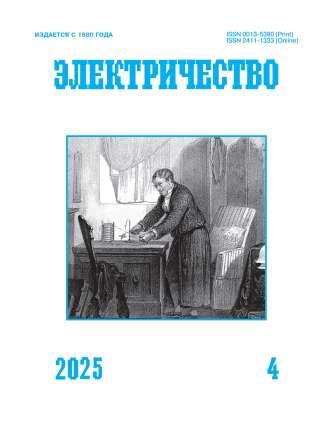
No. 4 (2025)On the Cover – Alessandro Volta is experimenting with his electric battery. Lithograph of the Florentine company Ballagny e Figli.
Source: Pistelli G. Storia d'Italia dal 1815 fino alla promulgazione del Regno d'Italia narrata al popolo. Firenze: Angelo Usigli editore, 1864, 963 p..
225 years ago, in 1800, the great Italian scientist Alessandro Volta created the first electric battery in history, which consisted of copper and zinc discs soaked in electrolyte (volt column). This invention was a powerful impetus in the development of the science of electricity.
-
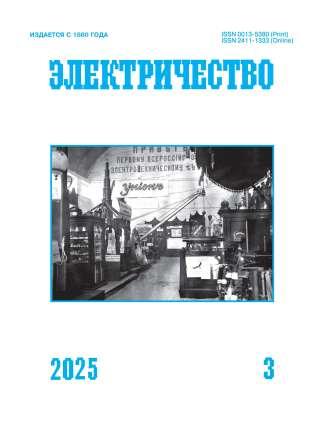
Issue № 3
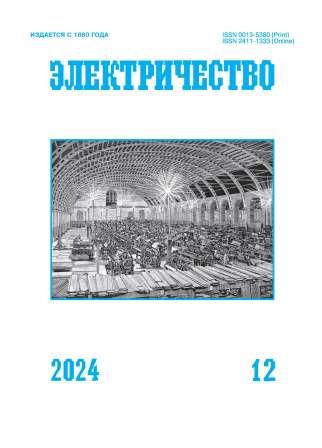
No. 3 (2025)On the Cover – The exposition of the exhibition. The first All-Russian Electrotechnical Congress, 1900.
Source: Al'bom uchastnikov pervogo Vserossiyskogo elektrotekhnicheskogo s"ezda: 1899–1900 (Album of Participants of the First All-Russian Electrotechnical Congress: 1899-1900), SPb.–M.: Tip. N.I. Grosman i G.A. Vendel'shteyn, 1900, 71 l.
125 years ago, the First All-Russian Electrotechnical Congress was held in St. Petersburg, dedicated to the "century of electric current" and gathered more than 650 participants. The organizer was the VI Department (Electrotechnical) of the Imperial Russian Technical Society. One of the events of the congress was the Exhibition of the Latest Discoveries and Inventions in the Field of Electrical Engineering.
-
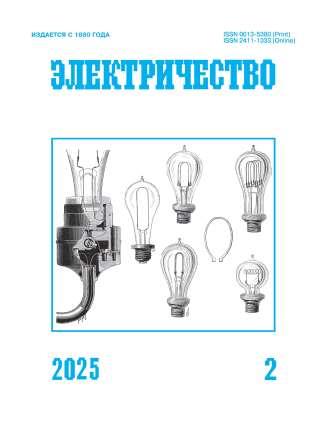
Issue № 2
No. 2 (2025)n the Cover are Edison's Lamps.
Source: Figuier L. Les Nouvelles Conquêtes de la Science. L’Électricité. Paris: Librairie Illustrée, 1884, 644 p.
In 1877, Thomas Alva Edison began experimenting with electric lighting based on the main principle of convenience for the consumer. Thousands of expensive experiments with platinum wire, carbon elements made of bamboo fiber, paper, and charred threads led to the first patent for an incandescent lamp in 1879. In 1880 (145 years ago) Edison launched these lamps into mass production, which eventually led to the process of worldwide electrification.
-
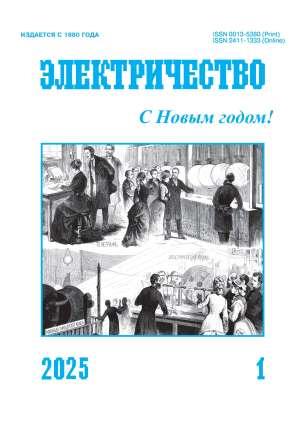
Issue № 1
No. 1 (2025)On the Cover is the First Russian Electrotechnical Exhibition in 1880 (Illustration by A.F. Baldinger).
Source: Baldinger A.F. Vsemirnaya illyustratsiya – in Russ. (World Illustration), 1880, No. 591.
The first Russian electrotechnical exhibition on the territory of the Salt Town in St. Petersburg was held in March 1880 by the newly created VI (Electrotechnical) department of the Russian Technical Society. A specialist was present at each stand, telling visitors about the operation of a particular device. Such guides were called "explainers", and at the exhibition they were famous electrical engineers: P.N. Yablochkov, V.N. Chikolev, D.A. Lachinov and A.M. Butlerov. With the funds raised from this exhibition, the publication of the magazine "Electricity" was organized.